I submitted my PhD. Now what?
Done?
Disappeared?
I stopped blogging (and stopped most other things too).
Back in 2020 I made myself a promise: post regularly, and don't drop the ball even if life gets hard, busy, or altogether overwhelming. I mostly stuck to it. The timelines stretched, but I kept going, and I was proud of that.
Then the PhD hit its final hot phase. And guess what? The promise went out the window.
Honestly, it took a toll on me. Physically (leaving the house less and less in the final weeks), mentally (grappling with the deadline), and emotionally (sometimes forgetting this was something I was actually interested in).
And when I finished (submitted, but still waiting on the official email to hit), the question showed up. Now what?
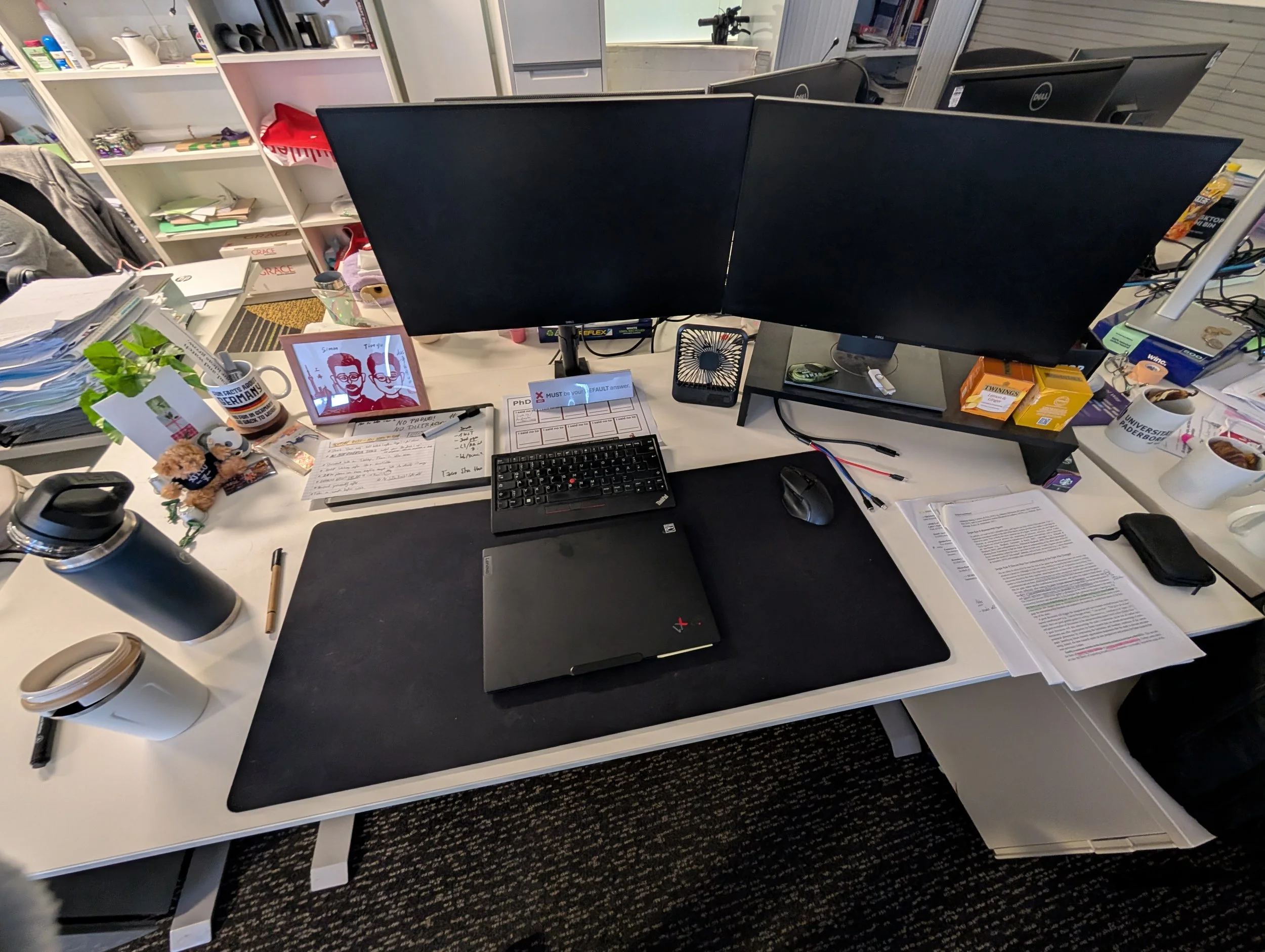
My desk before I cleared it. Love the handmade paper picture of me and Ricardo from our conference trip to Shanghai, it still makes me laugh.
Source: Simon Beuse, 2026, UQ
Curiosity, and not being able to sit still on the sidelines
After submitting I took a proper break in Europe. No email checks. The stress came down. Anyone who has done a PhD knows it isn't really "done" at that point: examination, corrections, oral exams and formal checks still take months, and I intend to see all of that through properly.
But the biggest part is behind me.
So the next step is to publish. Right?
I'm not so sure.
The leads are there. I wrote the PhD in paper format, I have had informal interest in much of the research, and I have a supervisory team and examiners that genuinely care about me and the topic.
But here is what changed: In the last months of writing I felt like I was rewriting for other people rather than following what I was curious about (I know this is a normal feeling but still). The research covers digital technologies and AI as what it looked like four years ago. That doesn't bother me on its own, because the point was always the overarching patterns rather than the specific tools. What bothers me is that the abstraction work is finished. I have the patterns. Sitting with them for another few years of journal review, while AI moves into physical space faster than anyone can write about it, is where I am unsure if my curiosity and value are worth the most.
Maybe they are also worth a lot when applied.
Demos vs. reality
Like you, I see what is on social media and YouTube. People posting insane things done with AI. Most of it is a demo. Look what this one can do! And this one! Did you see the other one?
However, putting any of it into reality is a different beast. It takes dabbling in and out of technologies, experimenting, and most of all being curious. There is a lot of noise in this space, and a lot of people selling slide decks about AI who have never shipped anything with it.
Spending time at an SF AI startup showed me that gap between what a system can demo and what a business can actually run on is the thing I keep coming back to.
That is where my curiosity is going now. The hands on stuff. I can't wait to try things again, the way I did as a kid when my dad handed me his old government PC that he no longer needed (don't worry, German state, the HDD was already gone).
And there is no deadline anymore. I have to set those myself.
So here is one: create the materials and find the use cases to deploy AI properly, by the end of the year.
Want to come along?
What I'm doing now
This is SCARY.
Walking away from an academic career people tell me I am so well set up for? Scary.
Walking away from a job with good pay right out of uni? Scary.
Living in two countries, with businesses that are still in their starting phase? Scary.
Speaking on non-academic panels and presenting fresh research results to that kind of room? Scary.
But none of it is as scary as not having my hands right there, on the technology, with other founders, in the excitement of an abundant future. However it ends up looking.
You have to be in it to win it (I remember my supervisor Henri telling me this all the time). In my case: to satisfy my curiosity without the pressured timelines and constant activity stacking.
Because looking back, I almost never got into the mental “flow state”, a mental state of complete immersion, energized focus, and deep involvement in an activity, anymore. It seems that in the end I was simply running on stress alone. I could focus only because the deadline was too close to ignore. Curiosity killed. Joy gone.
But I know this is not the same for everyone, and people perceive stress differently. That is why I also often see a lot of joyous academics who can’t get enough of their research. And that is so cool! But being honest with myself, it is just not me.
None of this is fun and games all the time. Sure, things get hard. But this stress is a different kind, and I think this kind simply suits me better.
And right now I really, really want to see what happens as AI moves into physical space. I think I have a lot to contribute.
Finding the next tree
Alongside the research (expect a playbook or something similar like it soon), I want to find the next tree.
Here is what I mean by that. I don't want to map the whole forest before I start. I don't want a three year plan. I want to find one tree, climb it, see what is up there, and let that decide the next one. Something concrete to apply the research to rather than rewrite it. Something where I can put agentic AI, AI strategy and a bit of robotics against a real problem and learn by doing it badly first.
Thinking back to innovation sessions at UQ, one thought kept coming up: don't start building yet. You do not know what your customer wants. Heck, you don't even know what you can build.
So the tree comes before the plan.
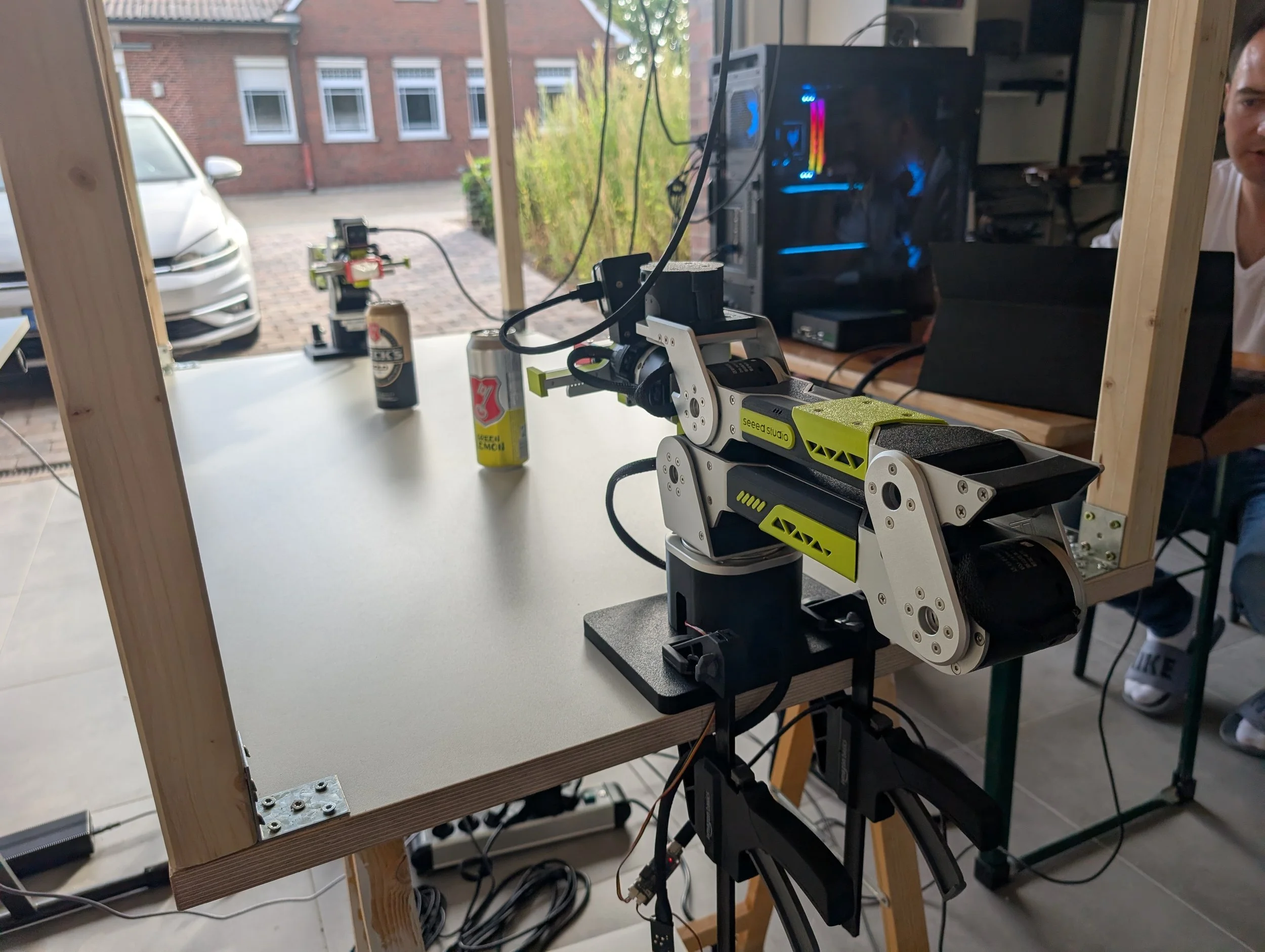
Naturally, the first robotics test subject was a northern-Germany classic: stacking Beck’s beer cans from Bremen.
Source: Simon Beuse & Fabio Maier, 2026, Lohne, Germany
Can I ask you a question?
Do you know someone running a factory, workshop or warehouse who is excited about AI on the shop floor but has no idea where to start? Someone with a fiddly, repetitive, unglamorous process that nobody has ever managed to automate, who would be open to seeing whether we could build something with a robot? Or someone who’d like to prep their manufacturing staff and educate them either via a hackathon or via co-developed, specialized seminars in order to help them understand what they can currently do, and, more importantly, what they can do in the future so they are ready?
Here is what is in it for them. Weeks of my time and my co-founder Fabio’s, a clear indication on whether their problem is actually solvable with what exists today, and early sneak peeks to the playbook we are writing out of it. We get a real use case instead of another demo.
Do you know someone who knows someone who… (you get it)!
Note: Select parts of this post used LLMs to polish and speed up the publishing process. All blog posts remain carefully checked, accurate, and original.
